Updated: July 2026
North Bali Travel — 25 Best Things to Do in North Bali (Ranked…
North Bali Travel is a curated Indonesia luxury tourism experience offered by Northbalitravel Co.: handpicked routes, vetted operators, transparent pricing, and 24/7 concierge support across Indonesia.
- What makes North Bali Travel a premium experience.
- How Northbalitravel Co. curates exclusive access and concierge logistics.
- Routes, seasons, and pricing transparency — no hidden fees.
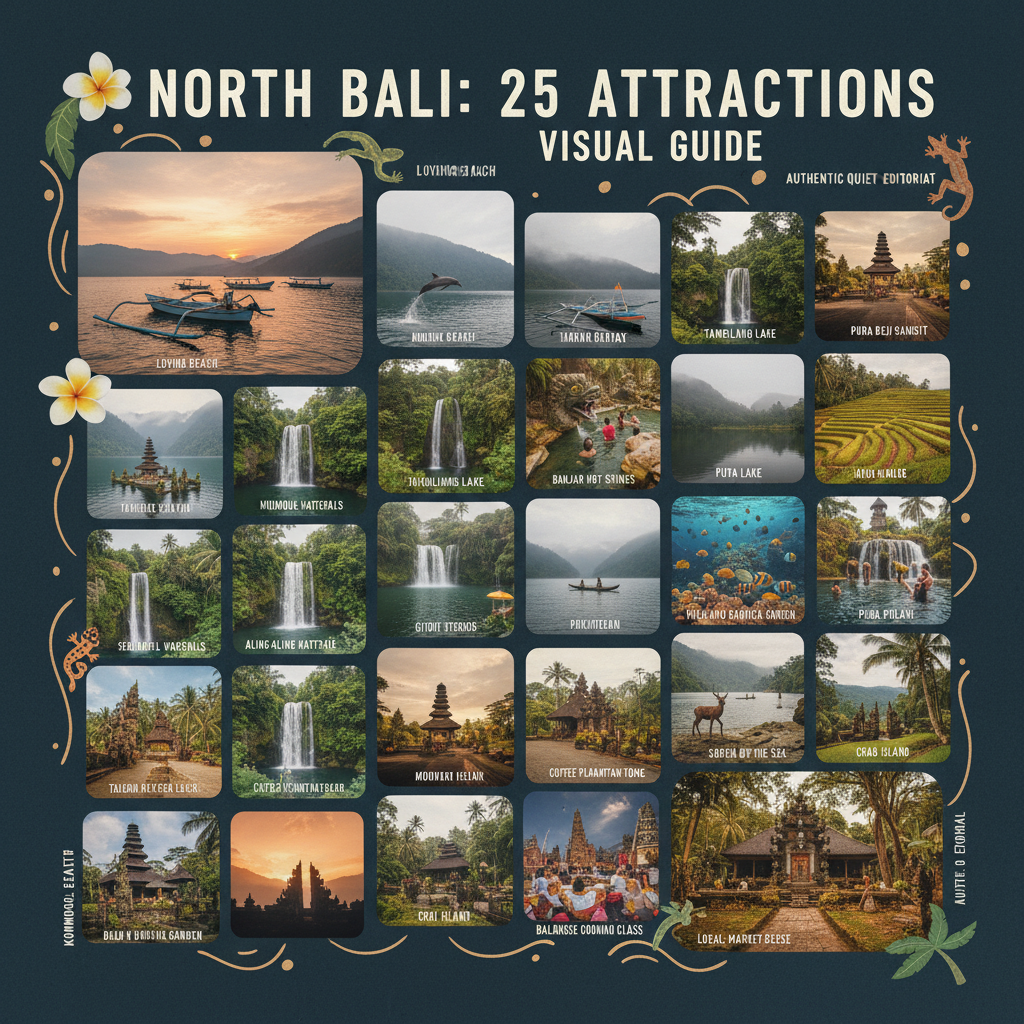
25 Best Things to Do in North Bali, Ranked by Experience Type
What Counts as North Bali?
North Bali, in tourism terms, refers to the territory north of the central volcanic spine, which includes Buleleng Regency along the entire north coast and the highland villages of Munduk, Wanagiri, and Pancasari that sit on the northern slopes of Mount Batukaru. Geographically this covers roughly forty percent of Bali island but receives less than ten percent of the tourist arrivals. The twenty-five places below represent thirteen years of guiding clients through this region, and we have ranked them by experience type rather than a single popularity score because the right answer depends on what kind of traveler you are. Times, locations, and difficulty are based on our most recent visit within the past ninety days. Bali tourism portal
Waterfalls (1 to 8)
1. Sekumpul Waterfall
Location: Sawan, 15 km southeast of Singaraja. Duration: 3 hours total. Difficulty: moderate to hard.
The seven-tier cascade widely considered the most spectacular on Bali. The full hike includes a steep concrete staircase descent (approximately 540 steps), a river crossing requiring you to wade through knee-deep water, and a final boulder scramble to the base of the tallest fall. From the viewpoint platform you can see the seven streams independently, an angle that has no equal on the island. Best between 9am and 11am for light hitting the upper falls. Entry fee IDR 125,000 includes the mandatory local guide. See our Sekumpul versus Gitgit comparison for help choosing.
2. Banyumala Twin Waterfall
Location: Wanagiri, near Munduk. Duration: 1.5 hours. Difficulty: moderate.
Two parallel streams falling into a single turquoise pool. The hike down is fifteen minutes on a steep but well-maintained path. The pool is swimmable and the photo angle from the wooden viewing platform is one of the best in North Bali. Less crowded than Sekumpul because the road in is rough. Entry IDR 30,000.
3. Aling-Aling Waterfall and the Sambangan Twin Falls
Location: Sambangan village. Duration: 2 to 4 hours. Difficulty: moderate, with optional cliff jumps.
The Sambangan circuit includes Aling-Aling, Kroya, Pucuk, and Kembar falls in a single trekking loop. Kroya offers a natural water slide. Aling-Aling has a five-meter and ten-meter cliff jump option for travelers who want adventure (mandatory guide and life vest, very safe in our experience). The lighting is best in the afternoon. Entry IDR 125,000 with guide.
4. Munduk Waterfall (Red Coral)
Location: Munduk village. Duration: 1.5 hours. Difficulty: easy to moderate.
A sixty-meter single drop accessed by a thirty-minute walk through a clove and cocoa plantation. The trail is paved most of the way. The pool at the base is shallow and not great for swimming but the spray and the canyon walls make it an excellent photography spot. Often called Red Coral because of the rusty mineral color of the surrounding rocks.
5. Melanting Waterfall
Location: Munduk village (twenty minutes walk from Red Coral). Duration: 1 hour. Difficulty: easy.
Easier access than Red Coral and a wider, lower fall that suits family groups. Often combined with Red Coral and Labuhan Kebo as a three-waterfall Munduk loop.
6. Gitgit Waterfall
Location: Gitgit village, 11 km south of Singaraja. Duration: 1 hour. Difficulty: easy.
The most accessible waterfall in North Bali and the one your driver will suggest if you are short on time. The walk in is paved and ten minutes, the fall is forty meters straight drop, and the pool is swimmable. Crowds peak between 11am and 2pm. Visit before 9am for the best experience. Entry IDR 20,000.
7. Nungnung Waterfall
Location: on the road from Bedugul to Pelaga, technically central Bali but on the North Bali tour route. Duration: 90 minutes. Difficulty: moderate.
Five hundred and nine steps down to a thunderous fifty-meter fall. The volume of water is the highest on this list and the spray is intense. Strong swimmers can enter the pool but the current is significant. The climb back up is genuinely difficult, allow forty-five minutes.
8. Tibumana Waterfall
Location: on the route between Munduk and Lovina. Duration: 45 minutes. Difficulty: easy.
A small, photogenic horseshoe fall that suits travelers who want a waterfall experience without committing to a long hike. Pool swimmable, often empty in the morning.
Coastal and Marine (9 to 14)
9. Lovina Dolphin Watching at Sunrise
Location: Kalibukbuk pier, Lovina. Duration: 2 hours on water. Difficulty: easy.
Wild dolphin pods follow a consistent dawn migratory pattern off the Lovina coast year-round. Boats depart at 5:30am. We strongly recommend selecting your operator carefully, see our honest assessment of Lovina dolphin tours for which boats follow ethical guidelines.
10. Menjangan Island Snorkeling
Location: West Bali National Park, accessed from Pemuteran. Duration: full day. Difficulty: easy.
The wall reef on the south side of Menjangan drops from three meters to forty meters within twenty meters of shore. Visibility consistently above twenty meters. The temple anchor site holds a wreck-like Balinese shrine at eight meters depth. The best snorkel destination in Bali by a clear margin.
11. Pemuteran Reef and Biorock Project
Location: Pemuteran beach. Duration: 2 hours. Difficulty: easy.
The largest and longest-running artificial reef restoration project in the world. The structures are visible from shore and snorkeling among them is one of the most accessible ways to see hard coral colonies recovering. Entry by donation to the Biorock Foundation.
12. Lovina Coral Garden Snorkeling
Location: Kalibukbuk shore. Duration: 1 hour. Difficulty: easy.
A shallow shore-snorkel option for travelers who do not want to charter a boat. Coral cover is moderate, fish life is decent, and the entry is from the beach. Good for first-time snorkelers and families with children.
13. Banjar Hot Springs
Location: Banjar village, 10 km west of Lovina. Duration: 2 hours. Difficulty: easy.
Three pools of natural sulphur water in a tropical garden setting. Maintained at thirty-seven degrees Celsius year-round. Most enjoyable in the morning before tour buses arrive at 11am. Entry IDR 30,000.
14. Tejakula Old Bathing Pools
Location: Tejakula village, far east north coast. Duration: 1 hour. Difficulty: easy.
Royal-era stone bathing pools fed by mountain springs. Local family bathing happens here, observe etiquette and dress modestly. Free to visit, donations welcomed.
Highland and Trekking (15 to 19)
15. Munduk Twin Lakes Ridge Hike
Location: Munduk to Tamblingan trail. Duration: 3 hours. Difficulty: moderate.
The ridge above Tamblingan and Buyan lakes provides the most photogenic high-altitude view in Bali. Best at sunrise. Local guide recommended for the route, available from any Munduk guesthouse for IDR 250,000.
16. Tamblingan Lake Dugout Canoe
Location: Tamblingan lake. Duration: 90 minutes. Difficulty: easy.
Traditional wooden canoes paddled by local fishermen. Quiet, contemplative, and the lake has no motorboats by tradition. Especially beautiful in the morning mist. IDR 200,000 per canoe (up to three passengers).
17. Mount Batur Sunrise Hike (from Munduk base)
Location: Kintamani, accessed from Munduk via 90-minute drive. Duration: 6 hours. Difficulty: moderate to hard.
Active volcano summit at 1717 meters above sea level. Departure 3am, summit at 6am for sunrise over Mount Agung. Cooked-on-volcano-steam eggs at the top. Mandatory local guide.
18. Wanagiri Hidden Hills Viewpoint
Location: Wanagiri ridge. Duration: 30 minutes. Difficulty: easy.
The famous swing and nest platforms over the twin lakes. Touristy but the view is genuine. Visit early or late to avoid crowds and waiting times. IDR 100,000 includes one swing photo with the operator using your camera.
19. Pancasari Strawberry Stop
Location: Pancasari, between Bedugul and Munduk. Duration: 30 minutes. Difficulty: easy.
Pick-your-own strawberry farms with views over the Bedugul plain. Ten minutes is enough but families with kids can spend more.
Cultural and Historical (20 to 25)
20. Brahmavihara-Arama Buddhist Monastery
Location: Banjar Tegeha. Duration: 1 hour. Difficulty: easy.
The only Buddhist monastery on Bali. A working meditation center with a Borobudur-replica stupa. Sarong required (provided at entrance). Free entry, donations encouraged.
21. Ulun Danu Beratan Temple
Location: Bedugul. Duration: 90 minutes. Difficulty: easy.
The lake-floating pagoda temple that appears on the IDR 50,000 banknote. Best between 7am and 9am. Temple festivals occur on the Galungan and Kuningan dates, very photogenic if you time it.
22. Singaraja Old Port and Dutch Quarter
Location: Singaraja old town. Duration: 1 hour. Difficulty: easy.
The original colonial-era capital of Bali under Dutch administration. Old warehouses, the original harbor, and the lion statues at the port square remain.
23. Gedong Kirtya Lontar Library
Location: Singaraja. Duration: 1 hour. Difficulty: easy.
The only library in the world dedicated to Balinese lontar palm leaf manuscripts. The librarian-curators will demonstrate the engraving technique.
24. Pulaki Temple Monkey Forest
Location: Pulaki, on the road to Pemuteran. Duration: 30 minutes. Difficulty: easy.
Coastal temple with resident macaque population. Watch personal items, the monkeys are practiced thieves.
25. Ponjok Batu Beach Temple
Location: Tejakula. Duration: 30 minutes. Difficulty: easy.
A small temple set on a black volcanic rock outcrop directly on the sea. Sunrise location, very few tourists, often you have it to yourself.
How to Combine These Into a Trip
Most travelers can fit eight to twelve of these into a three day two night North Bali loop, or fifteen to twenty into a five day four night extended trip. Our standard 3D2N covers numbers 1, 4, 5, 6, 9, 13, 15, 18, and 21. Our 5D4N adds 2, 3, 10, 11, 16, 20, and 22. See our North Bali travel page for full itinerary structure and pricing, or for Munduk specifically the three day Munduk itinerary.
Is North Bali Worth Visiting? A Candid Assessment for the Discerning Traveler
For travelers whose metric for a successful Bali holiday is measured by tranquility and authenticity rather than nightlife and beach clubs, North Bali is not just worth visiting—it is essential. The region represents a return to an older, more serene version of the island, a pocket of unspoiled Bali where the rhythm of life is dictated by ceremony and the harvest. It stands in stark contrast to the congested, albeit vibrant, southern corridors. The question is not whether the North is valuable, but whether its specific brand of quiet luxury aligns with your travel objectives.
The primary draw is the dramatic, volcanic landscape. This is a region of towering waterfalls, not beach bars. Days here are spent on active pursuits, such as challenging hikes to the majestic Sekumpul waterfall, a cascade often cited as Bali’s most beautiful, or engaging in contemplative Munduk trekking through clove and coffee plantations. The air is cooler, the vistas are dominated by mountains and serene caldera lakes like Tamblingan lake, and the coastline, particularly around Lovina beach, is defined by calm waters and black volcanic sand, offering a different coastal energy entirely. This is the Bali for photographers, nature enthusiasts, and those seeking a profound sense of peace.
Luxury in the North is less about ostentatious displays and more about deep integration with the environment. It manifests in private villas with infinity pools that disappear into the jungle canopy, bespoke culinary experiences featuring locally sourced ingredients, and exclusive access to natural wonders before the crowds arrive. It is an intellectual and restorative form of travel, appealing to those who prefer the quiet satisfaction of a mountain sunrise to the thrum of a sunset party. If your goal is to disconnect from the world and reconnect with nature in a sophisticated and private setting, then the North is unequivocally the superior choice. For a deeper look into crafting such an experience, explore our detailed Munduk itinerary for inspiration.
Ultimately, North Bali is for the traveler who has graduated from the typical Bali experience and seeks something more substantive. It requires a greater investment in travel time but rewards the effort with serenity and access to the island’s natural soul. To understand how these elements can be woven into a seamless journey, we invite you to explore our services for creating bespoke North Bali travel experiences.
How to Get from Ubud to Munduk: A Guide to Private Transfers and Scenic Routes
The journey from the cultural heart of Ubud to the mountain sanctuary of Munduk is a transition between two distinct facets of Bali. While geographically not a vast distance—approximately 60 kilometers—the winding mountain roads make the mode of transport a critical component of your experience. For the discerning traveler, a private vehicle with a professional driver is the only logical and comfortable option. This approach transforms a simple transfer into an integral part of your North Bali discovery, offering flexibility, safety, and the opportunity to witness the island’s remarkable interior at your own pace.
A direct transfer typically takes between two and two-and-a-half hours, navigating through rural villages and ascending into the central highlands. However, the true value lies in curating the journey as a private scenic tour. The route is dotted with some of Bali’s most iconic landmarks, which can be seamlessly integrated into your transfer day. A highly recommended itinerary includes a stop at the serene Pura Ulun Danu Bratan, the quintessential water temple that appears to float on Bratan lake. Further along, the famous Bali Handara Gate offers a formidable photo opportunity, framing the lush mountains beyond. For the more adventurous, a brief detour can lead to a viewpoint overlooking the magnificent Banyumala twin waterfalls, a perfect preview of the natural wonders that await in the North.
Private Transfer Options: Ubud to Munduk
| Transfer Style | Typical Duration | Key Inclusions | Best For |
|---|---|---|---|
| Standard Private Transfer | 2 – 2.5 hours | Point-to-point service, professional driver, premium vehicle, water. | Travelers on a tight schedule or those who prefer to settle in quickly. |
| Customized Scenic Tour | 5 – 8 hours | All standard features plus a custom itinerary with 2-3 stops (e.g., temples, viewpoints). | First-time visitors to the region, photographers, and those wanting to maximize their time. |
Opting for a customized tour allows you to arrive in Munduk already oriented with the region’s geography and cultural highlights. It removes the need to backtrack later, saving valuable holiday time. After a day of curated exploration, you can arrive at your villa ready to relax, having already experienced some of the area’s most compelling sites. This is the essence of efficient and luxurious travel planning, a core tenet of settling into your Munduk experience with grace.
A seamless transfer sets the tone for your entire stay in the highlands. It is the first step in immersing yourself in the tranquility of the North. For assistance with arranging your private transfer and crafting a personalized scenic route, our team is available to ensure your journey is as exceptional as the destination itself.
Sambangan Secret Garden: Entrance Fees, Private Guides, and What to Expect
The Sambangan Secret Garden, often associated with the powerful Aling-Aling Waterfall, is a concentrated adventure zone offering a series of cascades and natural pools designed for trekking, sliding, and cliff jumping. For the active traveler, it is a highlight of the North, but experience requires some forethought. Understanding the fee structure and the critical role of a local guide is paramount to a safe and enjoyable visit. This is not a casual waterfall visit; it is an immersive, guided activity.
Upon arrival, you will find a ticket office with a tiered pricing structure. It is crucial to distinguish between simple entrance and a guided activity package. The basic fee typically grants viewing access to Aling-Aling waterfall only, where swimming is forbidden due to its sacred status and powerful currents. The real experience lies in the guided trekking packages, which provide access to the adjacent waterfalls—Kroya, Kembar, and Pucuk—where you can slide down naturally formed rock faces and leap from platforms of varying heights (typically 5, 10, and 15 meters) into deep, clear pools. These packages include a mandatory local guide, a life jacket, and insurance.
We strongly advise against attempting this experience without a guide. The guides are not merely facilitators; they are safety experts. They know the water levels, the safe jumping points, and the proper techniques for sliding to avoid injury. They provide the confidence and instruction needed to fully engage with the activities. Attempting to navigate the slippery paths and powerful water flows alone is ill-advised. A private guide ensures your adventure is thrilling for all the right reasons, transforming a potentially hazardous outing into a managed and exhilarating experience, which can be a key part of any trip planned from your base in Munduk.
Prepare for the excursion by wearing secure water shoes or sandals with a good grip, not flip-flops. Bring a waterproof bag for your belongings and apply reef-safe sunscreen well in advance. The trek itself involves navigating steep steps and jungle paths, so a reasonable level of fitness is required. The experience is a physical and mental challenge that rewards participants with an memorable adrenaline rush set within a remarkable natural canyon.
Integrating an adventure like the Sambangan Secret Garden into your travels requires careful planning to ensure it complements the more serene aspects of your trip. To build this or other exclusive activities into a custom North Bali itinerary, our specialists can manage all the logistics, from private transport to securing the best local guides.
The Photographer’s Guide: Best Sunrise Spots in Munduk
Munduk’s elevated position, often shrouded in ethereal morning mist, makes it one of Bali’s most compelling locations for sunrise photography. For the serious photographer, capturing the dawn here is a rewarding technical and artistic challenge. The key is to move beyond the well-trodden viewpoints and understand how the light interacts with the unique topography of volcanic peaks, deep valleys, and caldera lakes. Success requires early starts, local knowledge, and the right equipment.
One of the most productive areas is the ridge overlooking the twin lakes, Buyan and Tamblingan lake. While many tourists flock to the “selfie parks” along the main road, superior, unobstructed vantage points can be found with a bit of exploration. Look for small warungs (local cafes) or clearings along the Jalan Raya Wanagiri that face east. The classic shot involves capturing the sun as it crests the distant Mount Batur and Mount Agung, its first rays piercing the valley mist and illuminating the tranquil surface of Tamblingan lake. A telephoto lens is essential for compressing the layers of the landscape and isolating details like the small lakeside temples or lone fishermen in their traditional *jukung* canoes.
For a different perspective, focus on the region’s cascading rice terraces. Unlike the vast, horizontal fields of the south, Munduk’s terraces are steeper and more dramatic. The optimal shot is often found by taking a short morning Munduk trekking route into the plantations. The goal is to find a vantage point where the rising sun side-lights the terraces, creating dramatic shadows and highlighting the vibrant green of the rice paddies. A wide-angle lens can capture the scale, while a polarizing filter will enhance the colors and reduce glare from the wet leaves. This is where our 3-day Munduk photography itinerary can provide specific, scouted locations.
Munduk Sunrise Photography Planner
| Location | Optimal Timing | Recommended Lens | Primary Subject |
|---|---|---|---|
| Tamblingan Lake Overlook | 30-45 minutes before sunrise | Telephoto (70-200mm) | Layered mountains, valley mist, lake reflections, distant volcanoes. |
| Terraced Rice Fields | 15 minutes before to 1 hour after sunrise | Wide-Angle (16-35mm) | Light and shadow on terraces, textures of the paddies, local farmhouses. |
| Private Villa Balcony | At sunrise | Varies (Prime or Zoom) | Infinity pool foreground, panoramic valley view, ultimate comfort. |
Perhaps the most luxurious option is a carefully selected private villa with an east-facing terrace. The ultimate photographic luxury is the ability to set up a tripod in the comfort of your own space, capturing the changing light over an infinity pool that melts into the valley below. This eliminates travel time in the dark and allows you to react instantly to the fleeting moments of perfect light.
Capturing the definitive Munduk sunrise requires more than just being there; it requires precise positioning and timing. For discerning photographers interested in maximizing their opportunities, we specialize in planning a photography-centric tour, complete with private guides who understand the nuances of light and location.
Securing Your View: The Definitive Guide to Luxury Private Villas in Munduk
In Munduk, the concept of luxury accommodation is fundamentally redefined. It is not about proximity to a beach or a bustling town; it is about the exclusivity of your view and the depth of your tranquility. The premier lodging experience is a private villa, architecturally designed to merge with the dramatic landscape of rice terraces, clove plantations, and distant volcanoes. Selecting the right villa is the single most important decision in crafting an exceptional North Bali sojourn, as it becomes the sanctuary from which all your experiences will originate.
The hallmark of a top-tier Munduk villa is an unobstructed, east- or north-facing panorama. This ensures you are greeted by spectacular sunrises and soft morning light flooding the valley. The most coveted feature is a private infinity pool, engineered to create a seamless visual transition between the water’s edge and the jungle canopy below. Given Munduk’s cooler, elevated climate, a heated pool is a premium amenity that significantly enhances the experience, allowing for comfortable swimming in the crisp mountain air. Discerning travelers should inquire specifically about the view’s orientation and the pool’s features when booking.
Beyond the view, true luxury is found in the details of service and design. The finest villas blend contemporary comfort with traditional Balinese aesthetics, utilizing local materials like volcanic stone and rich teak wood. In-villa services are what elevate a stay from great to extraordinary. Expect options for a private chef to prepare meals using ingredients from the villa’s garden, on-demand spa therapists for massages on your private terrace, and a dedicated villa manager who acts as a personal concierge. This level of service allows for spontaneity, whether you desire a last-minute guided Munduk trekking adventure or a private yoga session at dawn. A villa of this caliber serves as the perfect base for a Munduk itinerary.
Properties in this category are limited and in high demand. They are not typically found on mass-market booking platforms. Access is often through specialized travel designers who maintain a curated portfolio and personal relationships with villa owners. This ensures a perfect match between the property’s character and the client’s specific desires, whether the priority is romantic seclusion, family-friendly amenities, or a wellness-focused environment.
Finding the perfect villa is the cornerstone of a flawless North Bali experience. It is your private lookout upon one of the most beautiful landscapes on earth. We invite you to consult with our specialists to explore our portfolio of private villas and allow us to secure the ideal residence for your mountain retreat.
Plan Your North Bali Trip
Tell us which of these twenty-five most appeal to you and we will build the route. Email: [email protected] | WhatsApp: +62 811 2859 0000